Monday, May 18, 2015

Cheyenne, Trains, Immigrant Trails and Fort Laramie

As we headed north to Wyoming, the plan was to spend a couple of nights in Cheyenne, find out what else would be fun to see and do in Wyoming and eventually land at the Grand Tetons.  We ended up staying a week in order to take part in the annual Depot Days, a celebration that centers around the  important train history in Cheyenne.  We even joined their Depot Museum to take advantage of some member only functions.  It was fun  in that we were more a part of the local "train community" than had we only been part of the hoards.  The BIG attraction was the tour to the steam shop to see Big Boy under restoration.  More on that later.

Cheyenne has been a railroad town of great importance since 1867.  It is interesting in the less populated parts of the west to see the prominence of the rail industry.  It is in LA but obscured by the zillions of people, cars, housing tracts.....   Today there are 80 trains a day going through Cheyenne.

I was surprised to see a UP control tower on the bridge which takes vehicular traffic over the train yard.


 Sadly, our RV park is far enough away from the tracks that we don't hear the whistles and rumbling of those massive beasts.  When we are at the depot, you can't miss them as they travel through.  The depot is a beautiful sandstone structure with an art deco lobby.

Cheyenne Train Depot

Depot Lobby
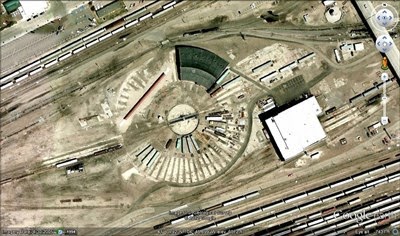
The original roundhouse was reduced in size once diesel replaced steam but a section of it remains.

Remaining roundhouse


While there is a are model trains in the museum, I am spoiled by the ones in Greeley, Co.

The big attraction for the serious train buffs was the tour to the steam shop to see Big Boy.  There are actually two in Cheyenne, one on static display in the park and one in the steam shop undergoing restoration.  Interesting that the latter lived for some time in Pomona, CA before being released by the museum for restoration by the Union Pacific in Cheyenne.

For train buffs, here is a summary of the Big Boys.  Those who could care less might scan it for a sense of how many points  I have racked up this last week.  BTW, Pink Points do not expire, Blue ones do.  More  on the Pink and Blue RV rules some day.  Not original with me.


During the late 1930s, the Union Pacific often used helpers to move trains from Ogden to Wahsatch. The UP wanted to simplify this move so they asked their "Department of Research and Mechanical Standards" (DoRMS) to design a locomotive that could pull a 3600 ton train unassisted over the 1.14% grade of the Wahsatch.The designers determined that to pull a 3600 ton train, a tractive effort of 135,000 lbs would be needed. Assuming a factor of adhesion of 4.0, the weight on drivers would have to be 4.0 * 135,000 = 540,000 lbs. Given an axle loading of 67,500 lbs each, this would require 8 drivers or an x-8-8-x wheel arrangement. The designers agreed upon the 4-8-8-4 design. Next, the horsepower and cylinder sizes were computed based on 300 psi boiler pressure. Although they weren't planning to pull these freight trains at 80 MPH, the DoRMS designed them for 80 MPH in order to have a sufficient factor of safety built into the design. What resulted is considered by many to be the most successful articulated steam locomotive ever built. 4000 was delivered to Omaha at 6PM, September 5, 1941.
The 25 Big Boys were built in two groups. The first group, called "class 1", were built starting in 1941. They were numbered 4000-4019. The second group, "class 2", were built in 1944. They were numbered 4020-4024. The last revenue freight pulled by a Big Boy was in July of 1959. Most were retired in 1961. The last one was retired in July of 1962. As late as September, 1962, there were still four operational Big Boys at Green River, WY.
The total mileage of each of the Big Boys from class 1 were roughly the same -- 1,000,000 miles. 4016 had the lowest mileage -- 1,016,124. 4006 had the highest mileage -- 1,064,625. Of the second group, 4024 had the highest mileage -- 811,956.

For the train buffs, here is a YouTube video of the 4014 leaving Pomona for Cheyenne and the restoration.  The beginning is better than the rest.

https://www.youtube.com/watch?v=WRxKpiD_ntY

BIG BOY

I was curious how the Union Pacific found people to work on the restoration of a steam locomotive.  I pictured a shop full of wizened old men in train overalls.  Here is the steam locomotive foreman-27 years old!

Locomotive Foreman

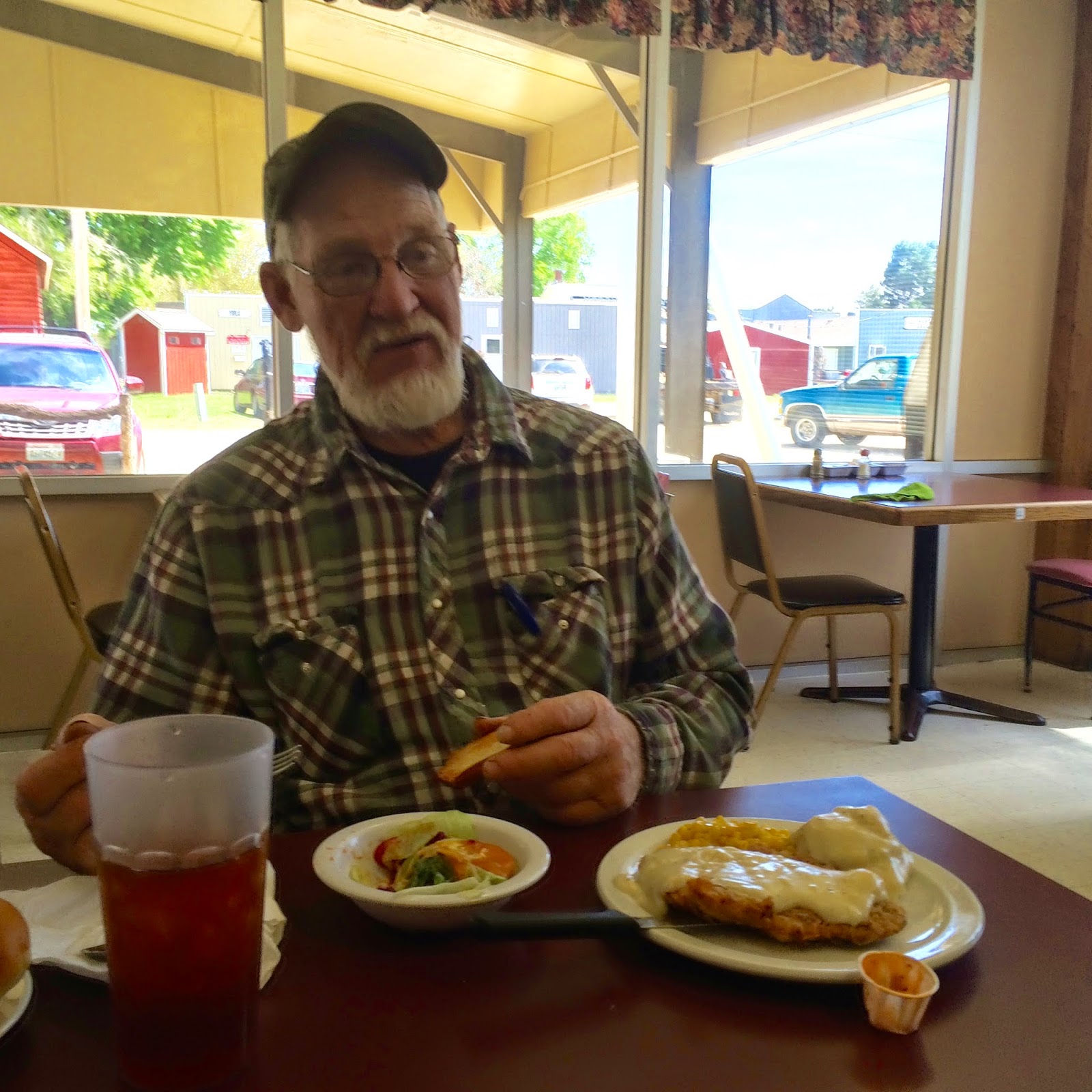
Curious as to  how such a young man would have the knowledge to oversee such an effort I asked (of course).  He explained that his family homesteaded at the turn of the century and that their ranch still had a variety of steam equipment.  He cut his teeth on steam tractors etc. so the job was a natural.  Talk about finding your passion in your job.

Over the last few years I have become interested in WWII history.  Not the battles so much but the stories of people, tragedy and incredible courage.  I was fascinated to find one of the 49 Merci Trains in Cheyenne at the VFW site.  Here is a bit about touching gesture of gratitude from the French people.

One of 49 Merci Trains


The "Forty-and-eight" boxcars


Photo showing the arrival of the Merci Train.
Forty-and-eights were French 4-wheel covered goods wagons used as military transport cars. The term refers to the cars' carrying capacity, said to be 40 men or eight horses.[4] Built starting in the 1870s as regular freight boxcars, they were originally used in military service by the French army in both World Wars, and then later used by the German occupation in World War II and finally by the Allied liberators.
In 1949, France sent 49 of those boxcars to the United States (one for each state then in existence and one for Washington, D.C. and Hawaii to share) laden with various treasures, as a show of gratitude for the liberation of France. This train was called the Merci Train, and was sent in response to trains full (over 700 boxcars) of supplies known as the American Friendship Train sent by the American people to France in 1947.
The Train and all 49 cars arrived aboard the Magellan bearing a banner which read: "MERCI AMERICA" on February 3, 1949, with over 25,000 onlookers in attendance. Immediately the trains were distributed amongst the states.

I found a lovely photo taken by the Depot Museum curator that I bought to replace the nondescript art that came with Pancho.  I looked him up at the Member's night event and he explained that he took the picture on the Chama Train, a narrow gauge steam train restored and maintained by volunteers with the support of both New Mexico and Colorado.  We have taken that trip so it was extra special.  He also explained, in enormous detail, every aspect of the two locomotives.  My head was spinning but I did love his enthusiasm.

Chama Steam Train Picture by Kerry Skidmore


Kerry, the Chama Train Photographer.


The old buildings in downtown Cheyenne are quite beautiful, as is the capitol.  

Downtown Cheyenne

Wyoming State Capitol

This statue fascinated the BD.  It is made from all kinds of metal tools.


A very fun side trip was to see the Oregon(California and Mormon at this point) Trail ruts.  It really brought home the difficulty of the journey.

Max and I are on the Oregon Trail.

I had never heard about the Mormon handcarts.  As I understand it, many of the Mormons wishing to go west did not have the funds to buy wagons and animals.  Instead, nearly 3,000 of them made the journey with handcarts, carrying young children and their meager goods.


Also nearby are the Register Cliffs where people making the trek would leave their names.


Fort Laramie was constructed in 1834, serving in the buffalo robe trade with Northern Plains tribes, later an important way station for the thousands of immigrants on the Oregon, California and Mormon trails and eventually it served as a military base in the Indian Wars.


Depiction of Fort Laramie

Sunday, May 10, 2015

Denver and Family


We have been in Denver for the last week and what a treat it is to see Chris and Christina, Maddie and Nori.  The girls are adorable and such fun.  Our arrival timing was great as they finally snagged their first house in a very hot market, which we got to tour along with Chris's Mom, Cookie.  It was fun seeing her before she returned to Hawaii.


The C & C live in and are buying their home in an area called Stapleton.  They are both going to work at the Children's Hospital which is just a few miles from Stapleton.  It is a very nice planned community of 6.4 square miles with about 20,000 residents.  There are over 900 acres of parks and open space and fun retail services, to include the yummy Four Friends restaurant where we had brunch yesterday.  The demographics of Stapleton seem to be young professionals with oodles of kids.  I mean they are everywhere, mostly under 7 or so.  There were about 20 at the small restaurant, dining and waiting.

Christina, Nori and Maddie, waiting for a brunch table


Chris , Christina and Nori

The Four Friends' Kitchen loans Etch a Sketches to the kids while they wait
Finding an RV spot in the greater Denver area proved to be a challenge.  The first place was close, right across from the beleaguered VA construction project and new light rail construction.  There were acres devoted largely to full time residents living in 5th wheel trailers.  The owner has owned the land for 25 years and is now neglecting the maintenance, charging outrageous fees and waiting for a developer to offer the right price.  I called it the Denver Dump.  Max however was quite fond of the park.  He passed his time watching rabbits cavort right under his window.  He named it Conejo Meadows.


After the weekend we moved to a nice state park for a few days until we headed north of Denver to an extremely nice, efficient and user friendly RV and Truck Service outfit.  The 6,000 mile chassis service is done and we are in their parking lot awaiting some additions to the coach on Monday.  As it  snowed last night, the electrical hookup is welcome.  The morning's excitement was a fox running across the parking area with a rabbit in its mouth.  Max was jealous.

Pancho and Lefty waiting for the Monday work.  Maybe we headed north a bit early?

Raggie was not too enthused to be awakened for this

Oh crap-at least we are parked and warm
The Denver area seems to be a magnet for young California transplants.  The development is everywhere, new housing, shopping centers, light rail and highway expansion.  Sadly, the traffic is part of that and after years on an island with no stop lights, we are eager to get back to a more rural environment.  Cities and RV's are not a mix we really like and most larger cities do not offer close in camping.  The payoff has been seeing family and stocking up at Trader Joe's.  We have make 3 trips since we will be heading for WY and MT where my Traders' app shows no stores in either state.

A funny note.  The variety and idiocy of various state liquor laws never cease to surprise me.  The first Trader's we visited in Denver carried wine, beer and a full selection of liquor,  though it was in a separate, adjacent room.  All others in Denver (and maybe the state) carry no alcoholic beverages.  One store only is allowed.  Of course, you can get pot in numerous locations.

Maddie and Nori are learning to shop at Traders at a good age.
We did a little sightseeing in the area.  The state park had some fun history of the stagecoach era coming to Denver.


We also visited the Greeley Model Train Museum.  The exhibits are amazing, representing the railroad world in 1975, to include an authentic dispatch station from that era.  As fun as the displays are, I got a kick out of all the old guys volunteering there.  They spend hundreds of hours at the museum, to the most certain relief of their wives.

 The scale of the trains is HO and there are also extremely talented (and patient) model makers who replicate scenery, buildings, vehicles and people.

Model trains with a real cabbose, built in the 20's, in the background

You push a button and a forest fire erupts


The conversation with Jake was fun as well.  He told of his Army career operating trains throughout the world.  For five years he ran the train that traveled into Berlin through East Germany.

Jake, the former Army train engineer

Saturday, May 9, 2015

Abilene, Abilene

As we headed out of Oklahoma towards Colorado to see my niece and her family in Denver, we decided to go via Abilene, Kansas, a first time in that state.  The attraction was the Eisenhower Presidential Museum.  The plan was to see the museum, spend the night and head out.  While Abilene may not be the prettiest town I have ever seen, it is attractive and the girls ( and boys) are not mean.

https://www.youtube.com/watch?v=Q3RF3nbreBE


Examples of the numerous beautiful Victorians, evidence of Abilene's prosperous past


"Abilene was an obscure, dingy place, boasting of but one shingle-roofed building, the balance a half-dozen log huts covered with dirt roofs" according to Joseph McCoy who conceived the plan to unite Texas Longhorn cattle with buyers in the east.


While the town no longer prospers from cattle drives, it remains a rail center for the transport of grain.  New grain holding facilities are under construction.

We stayed at a pleasant RV Park that was a mile or so down from the major attractions.  It bordered an alfalfa field and was not too far from the trains.  If the sounds of trains annoy you, it wouldn't be your stop but I love hearing them, even in the middle of the night.  I guess they appeal to my vagabond soul.

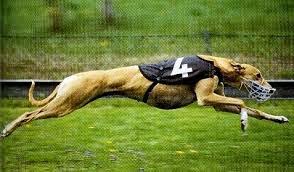
One unexpected attraction was the Greyhound Hall of Fame, mostly about the racing but also containing some history of the breed.  It is an ancient breed, almost extinct during the famine of the Middle Ages, and then saved and reserved for nobility.  In the 10th Century the King of Wales made killing a greyhound punishable by death and commoners were prohibited from owning the breed.  If caught, they were severely punished and the dog's toes were cut to prevent hunting.  It was tough being a commoner or a commoner's dog.

Greyhounds have been clocked at 45mph


While I don't really have an opinion about the racing industry's treatment of the dogs,  I did enjoy meeting the retired racers "hired" as greeters at the museum.  We have become interested in the group of dogs known as sighthounds after adopting Max, who we suspect may be part whippet given his speed and confirmation, endless watching out the window and prey instincts.


The Presidential Museum is a combination of Ike's childhood, military career, and of course his presidency.  As to the latter, there was a section commenting that during and shortly after his tenure as president he was minimized as a caretaker, golf playing president.  More recent thinking ranks him among the top 10 presidents.  The one thing that struck me was that given his vast military experience during the worst war the world has seen, where his diplomatic skills were a key to much of his success, that "picking one's battles" with patience and the long view was maybe one of his greatest strengths.

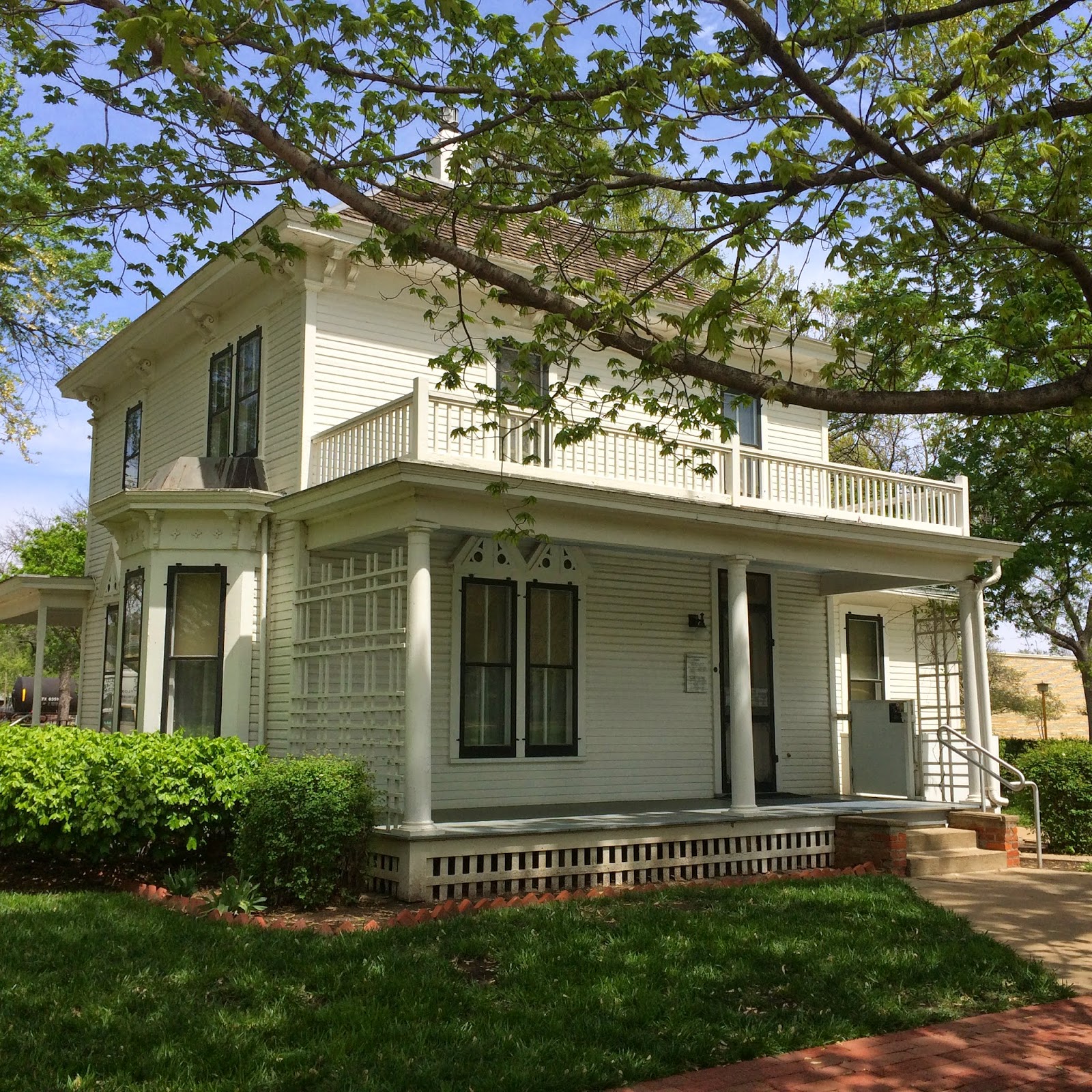
Ike grew up with five brothers, his parents and a grandfather in Abilene, Kansas.  His parents were devout River Brethren, a form of Mennonite with pacifist beliefs.
Ike's boyhood home, with a bedroom and kitchen added in later years

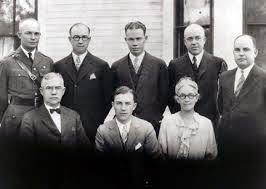
The family emphasized education and limited funds caused Ike to pursue an appointment to West Point where he could get a free college education.  All six boys became successful, a banker, lawyer, pharmacist, electrical engineer, college president and of course Ike.

Eisenhower Family
Much of the museum was devoted to his extraordinary career including the D-Day planning.  There were detailed scale models of the Normandy harbor built by the Allies-breakwaters and piers to enable the offloading of the massive shipment of military supplies and equipment once the invasion succeeded.  The Brits did the engineering and the infrastructure was built in Briton and towed to Normandy.  All in secret.  Amazing, conceiving and executing such an effort without benefit of today's technology.  Like previous military engagements, Ike wrote out remarks beforehand in the event of failure.  The D-Day invasion one remains:

Our landings in the Cherbourg-Havre area have failed to give a satisfactory foothold and I have withdrawn the troops.  My decision to attack at this time and place was based upon the best information available.  The troops, the air and the Navy did all that Bravery and devotion to duty could do.  If any blame or fault attaches to the attempt it is mine alone.

Fortunately, he never had to use his prepared remarks.

We know much about the Nazi horrors but this was a new one to me.


The section on the Cold War brought back memories of the drills and pamphlets about nuclear preparation.  I didn't realize that the government provided guidance and funding for the construction of bomb shelters.


One of Ike's better quotes:


I was also unaware that Eisenhower was responsible for the first federal civil rights legislation in nearly a century.


One of the really fun things about traveling is meeting people from different backgrounds.
A high point in Abilene was lunch with David.  We met him outside the local lunch spot when we inquired as to the food.  He agreed to join us and with my gentle interrogation,  we learned that his family immigrated from Switzerland, homesteaded in Kansas and he and his wife along with his son still live on the homestead and raise beef cattle.  He answered my endless questions about such activity and explained how modern technology is used in agriculture. As an example,  using GPS,  farmers can plant seeds within 2" of the previously applied fertilizer.  We later learned from the head of the local heritage museum that he has an amazing baritone singing voice.


The Abilene stop is proof once again that the high points of travel are often where you do not expect them.

Wednesday, April 29, 2015

Tornados. BBQ and History

Driving around NE Oklahoma we occasionally saw what appeared to be an old tornado shelter.


Coming from earthquake country, we became curious about this local threat.  I asked our camp manager when earthquake season began.  He was no doubt amused and said it was April and May.  He further explained that they had three places in the campground that would provide shelter, two cider block buildings and a steel tornado shelter that would accommodate 60 people, closely packed.  We also noticed that Lowe's sells shelters.  For only $2995 you can crawl into the WWII looking pillbox.  No claustrophobics here!


Add caption
We spent a good part of a day at Har Ber Village, a private living history museum.  We timed our arrival after the 500 school children left.  There were dozens of buildings, most log, depicting life in the 1800's.  Also displayed were endless collections of everything from farm equipment to household items.

An Alternative to Lethal Injection?


Natural Dyeing with tree bark from the Osage Orange

Osage Orange Tree, Used for Hedge Rows after the Dust Bowl

Very Hard Wood

While Oklahoma may not be a culinary destination we indulged in BBQ on two occasions.  BD opined as to how the ribs were the best ever.


Indian Territory

Recently the trip has become even more spontaneous.  Arkansas was a last minute choice, as I had heard that it is a pretty pretty place.  Yes it was.

The next choice was Oklahoma.  My only venture there was in the 70's, in January on I-40 in a snowstorm.  Coming from SoCal I remember being surprised that  the the trees had no leaves and the sky was gray-that is when it was even visible.

I picked a destination in the NE  of Oklahoma called The Grand Lake of the Cherokees.   That reminded me that, among other things, the state has important Indian history.  Because the trip to the lake was along the eastern edge of the state, it consisted of rolling hills, trees and creeks, I believe the western edge of the Ozark's.  The RV park was lovely and spacious, looking straight onto the lake over a wonderful dog walking field.


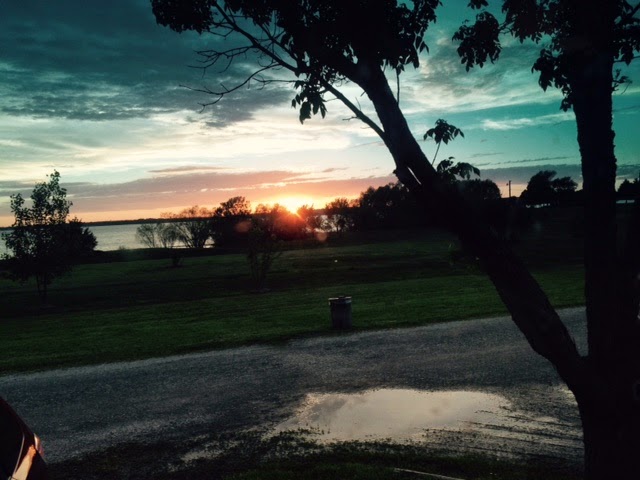
View of the Lake from the Campsite


BD was a good sport about backtracking to the town of Tahlequah, the headquarters of the Cherokee Nation for a visit to the Cherokee Heritage Center.  Included was an exhibit about the Trail of Tears.
While we now all recognize that booting people from their ancestral home was a tragedy, even then there were those who strongly objected.  The Supreme Court found the removal unconstitutional and the first military officer charged with executing the removal, horrified at his assignment, protested and was replaced with a more compliant commander.  A small number of Indians signed the treaty moving them west (only 300 were at the meeting).  They had no authority and despite a petition in opposition presented by the Chief with 15,000 signatures, the Senate approved the Treaty by one vote.  Even former President John Quincy Adams said the Treaty, "brings its eternal disgrace upon the country."  President Andrew Jackson is said to have commented that the Chief Justice could enforce his finding if he wanted (knowing of course that the court has no such mechanism).

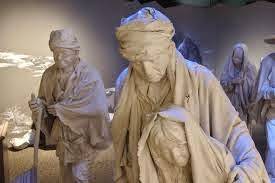
Haunting Statues Depicting the Trail of Tears


A little bit of Oklahoma Indian history as found at the museum.


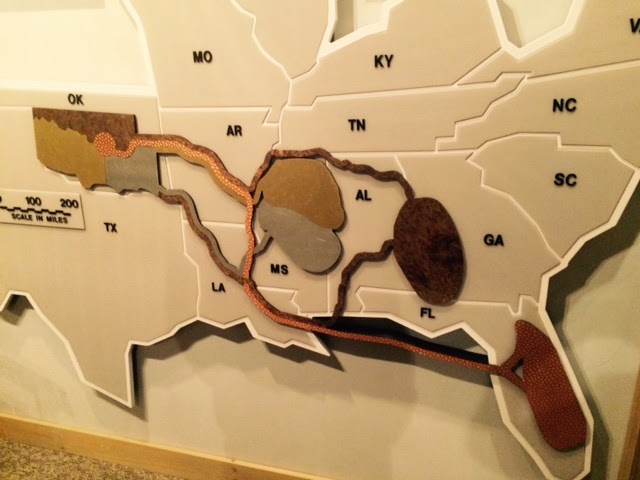
Original Lands and Routes of Removal for SE Indian Tribes

Chief Ross was the highly respected Cherokee Chief despite being only 1/8th Cherokee.  He had blue eyes, was well educated and a successful merchant and planter.  He also had slaves.

Reverend Worcester was very active in the protest of the removal, imprisoned for his efforts.  He translated the bible from Greek to Cherokee and was instrumental in establishing the Cherokee Phoenix Newspaper (still published) as well as school texts and institutions of higher learning.  When the Cherokee were removed to Oklahoma their literacy was greater than that of the local population in Oklahoma.

By 1840 about 100,000 Indians from different tribes had been removed from the Southeast.  The number of deaths from disease, exhaustion and starvation is unknown but among the Cherokees alone it is estimated to be 4,000.

After the Civil War former slaves of the Cherokee became Cherokee Freedmen and were granted citizenship in the nation despite having no Cherokee blood.  Today there is a controversy regarding the continuation of such membership by direct descendants of those former slaves.  There are currently about 25,000 descendants.


The Cherokee Heritage Center also has wonderful displays of life before removal from very early times as well as an area depicting post removal life.
These structures recreate Cherokee life in the SE in very early times

This is the way Cherokees lived in Oklahoma in the 1800's 
Today the Cherokee presence is apparent including many Cherokee nation license plates.